
As college students in the mid-1990s, my then-boyfriend and I sponsored a child together through Compassion International, a child development ministry dedicated to releasing children from poverty in Jesus’ name. By committing to donate a few dollars a month, we could correspond with a child registered in one of Compassion’s outreach programs around the world. I vaguely remember agreeing that if my boyfriend and I split, one of us would take responsibility for the child we’d sponsored together.
We asked for an orphan and were given young Mbabazi, whose parents and other family members had been murdered in the Rwandan genocide against Tutsi two years earlier. Through Compassion’s on-the-ground efforts, Mbabazi was receiving healthcare, education, and hope-filled lessons from the Christian faith. As Mbabazi’s sponsors, we received a brief bio and a 2×3-inch photo.
Studying the image stuck on the mini fridge in my dorm room, I felt unnerved. Mbabazi’s head had been shaved to better treat the scabies leaving scars across her scalp. Her arresting eyes held a disturbing closed-off expression. But what unsettled me most was the realization that an entire group of people, Mbabazi’s people, had been systematically and brutally killed—while I’d gallivanted through my teenage years unaware.
So I read everything I could find about recent and current events in Rwanda, a country I’d never noticed before. My reading expanded to bits about other places in East Africa. I started paying attention to the “world news” section of the local paper. And I wrote letters to Mbabazi telling her I was pleased to know her, proud of her efforts to do well in school, believed God had a plan for her life.
Within a year, my boyfriend and I were engaged to be married. Amidst the hoopla of wedding plans, I remember feeling relieved that my new husband and I would remain a constant in Mbabazi’s life.
In those days, sponsors received a printed photo of their child once a year. In Mbabazi’s next photo, she looked slightly less frightened, and her hair had started growing back. As each year passed, she looked more optimistic. One year she began smiling for the camera! She grew taller, shifted to wearing grown-up clothes, became a gorgeous young woman with a full head of hair and confident eyes. Eventually she aged out of the program, able to take care of herself.
As my husband is wont to do, he thoroughly investigated the financial records Compassion provides for transparency. Reassured, with our careers and finances stable, we sponsored more children, requesting orphans, children with special needs, siblings.
Meanwhile, we failed at creating our own family. It became emotionally taxing to answer a common get-to-know-you question: “Do you have children?” But whenever our Compassion children asked, I found joy in the answer: We don’t have children. We love you like you are our own daughter (or son). We’re so glad you’re part of our lives. Imagine the thrill when one of our Compassion children refers to us as their “dear beloved parents”!
During most of our thirty years with Compassion, we’ve been able to cover our monthly financial commitment. But there have been difficult times. Once, we had fallen behind and were trying to figure out how to come up with back payments. Compassion forgave our debt and let us keep our sponsored children, going forward simply by paying the next month’s commitment.
As technology improved, so did options for worldwide correspondence. Quarterly printed letters requiring weeks or months to deliver gave way to electronic messaging. Instead of one printed photo a year, we received frequent digital images and artwork. Leaders in Compassion communities began sending timely prayer requests. The ease of communication inspired me to establish a pattern of writing to our kids once a month.
Then, a few years ago, Compassion invited us into another opportunity. Generous corporate sponsorships covered physical needs—medical care, school supplies, community resources. But children with corporate sponsorships didn’t receive letters from a devoted individual, an integral part of Compassion’s mission. Would we consider corresponding with some of these children?
Of course we said yes. With enthusiasm!
Sometimes I wonder where Mbabazi, our first sponsored child, is now. Is she working as a seamstress like she planned? Does she have a family of her own? Are her children learning they too hold inherent value?
I can’t point to a single monumental way my life has changed through my experience with Compassion. And yet across the decades, my perspective shifted from what it might have been.
- I have loved children who were not my own, as my own.
- I learned to seek out trusted sources for world news.
- I have seen this miracle: One goat can move a family out of extreme poverty.
- We don’t run the faucet excessively at our house, because clean water is a precious commodity.
- Warm and dry under a protective roof, I feel gratitude. Same when walking into an air-conditioned room in the heat of summer. These are amenities to be thankful for.
- The first time a five-year-old signs their own name is a milestone indeed. Still, they might never outgrow sending (and receiving) “big hugs”!
- Not all children anticipate Christmas gifts. Some look forward to a restful day with their families, a tradition we too have adopted.
- Becoming a seamstress requires diligent study and hard work, mostly in the evenings after regular chores.
- The word “hope” can be translated many ways: I’m proud of you. I believe God has an excellent plan for your life. Thank you for being my friend. What are you learning? How can I pray for you? I love you now and always.
- Young men sharing barracks in the Bolivian military, praying for me and my husband? Never would have imagined it.
- Capybaras are intriguing little creatures! I learned about them from a child who wants to see a real one someday.
Though my husband and I would love for our correspondence with every child to continue forever, our time with each one inevitably ends. We’ve lost children to graduation, relocation, wartime unrest, trade school, seminary studies, mental illness, military conscription, marriage, nursing courses, university, business school. Sometimes we’re given enough notice to say goodbye, sometimes not. Always we are left with ongoing hopefulness for this extraordinary person who, having started out small and uncertain, is now making their way through the big wide world.
“May each day bring you new reasons to smile,” one child wrote in his final letter.
I can think of only one reply: Dear one, your prayer has already been answered.
Learn about sponsoring a child through Compassion.
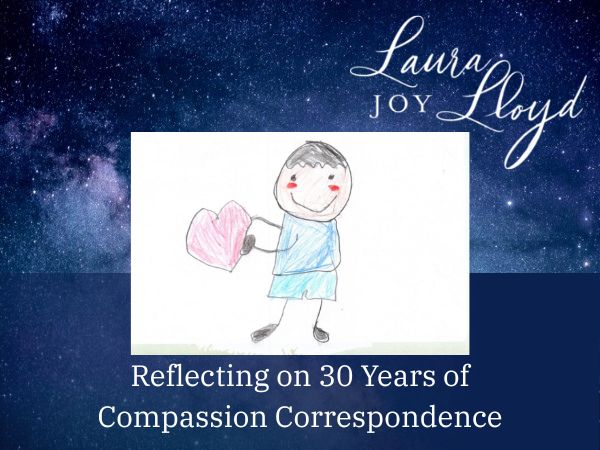
Artwork in featured image by Yosemir, age 6, Peru
(This post is adapted from a note I wrote Wren Islanders in the fall of 2026. If you’d like to be among the first to read fun stuff like this, subscribe to receive updates.)